

A hair topper covers a selected area of thinning and blends with the hair you already have. A full wig provides all-over scalp coverage. If you are comparing hair toppers and wigs in Cedar Rapids, start with how much coverage you want, how the piece feels and what you can comfortably manage each day. The haircut comes next.
At Hair Replacement Center of Iowa, you can explore women’s hair loss solutions, wigs and toppers in a private consultation. You do not need to arrive knowing which option is right for you. A useful first conversation starts with your questions, not a product name.
Hair topper vs. wig: what changes?
The National Alopecia Areata Foundation’s guide to wigs and toppers explains the basic distinction: toppers add partial coverage and blend with existing hair, while full wigs cover the scalp. Many toppers use clips attached to their base.
| Consideration | Hair topper | Full wig |
|---|---|---|
| Coverage | A selected area, such as the part or crown | All-over scalp coverage |
| Main styling question | How does it blend with my own hair? | Does the complete style look and feel like me? |
| Main fitting question | Where will the base and attachments sit? | How does the cap fit at the hairline, ears and nape? |
Neither category is automatically the better choice. Ask to discuss both if your priorities are mixed, such as wanting coverage at the crown but also wanting less daily blending.
Considering a topper? Look underneath first
A flattering color is only part of the decision. Ask the person fitting your topper to show you its underside and explain where it would sit on your head. Which area will it cover? Where will each attachment rest? Can you put it on and remove it comfortably?
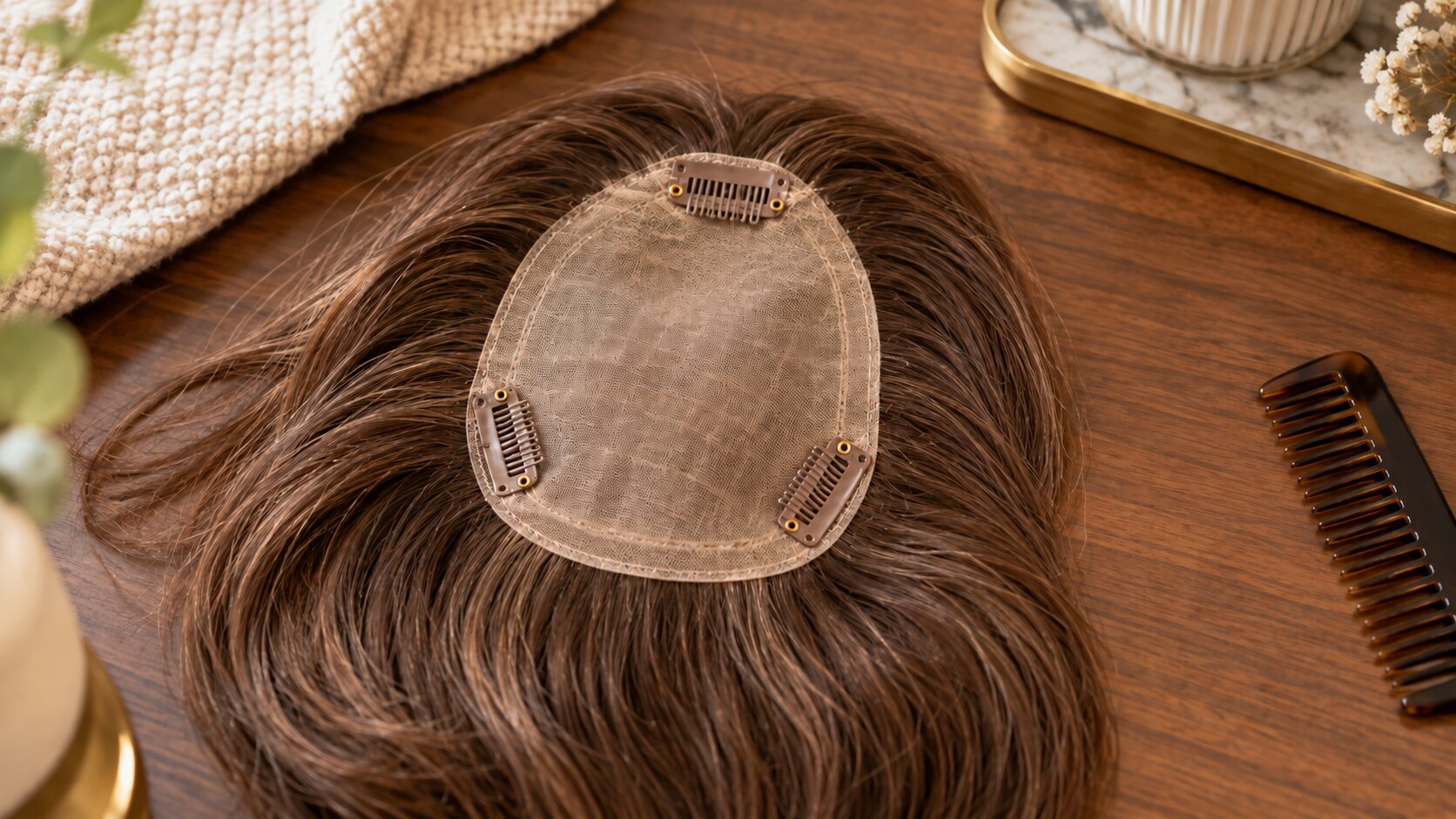
There is no single topper footprint. For example, manufacturer Jon Renau’s coverage and placement chart distinguishes pieces for the front, part, top and crown, with different base dimensions. This is a helpful illustration of why measurements matter, not a statement about HRC’s current inventory.
At your consultation, describe the view that bothers you most: a widening part in overhead light, the crown in photographs or a thinner-looking fringe. Then ask how a proposed piece addresses that particular concern. If an attachment pulls or feels uncomfortable, speak up instead of trying to tolerate it.
Considering a wig? Test an ordinary moment
When you try a wig, pause before judging only the front-facing mirror view. Put on the glasses you normally wear. Turn your head, look down as if reading your phone and check the side profile. Tell your fitter about pressure, movement or areas that feel unfamiliar.

Bring a photograph of a haircut you felt comfortable wearing, if you have one. Use it to discuss length, fullness, part placement and gray blending. You can also say what you do not want, such as more volume than you are used to or a style that requires a longer morning routine.
A wig does not automatically require shaving your head. NAAF’s wearing and care guide includes preparing existing hair beneath a wig. Ask for a demonstration suited to your hair and the specific cap.
Choose a care routine you will actually use
Both toppers and wigs come in different fibers. Traditional synthetic fiber generally holds its preset style; human hair offers styling flexibility but needs more styling care. Heat-friendly synthetic is a separate category, not permission to use any hot tool at any temperature. The NAAF fiber overview explains these differences.
Before purchasing, ask for the care instructions for that exact piece. Confirm suitable products, washing and drying steps, storage, heat restrictions and what to do if it tangles. NAAF’s care guidance is a useful starting point, but your piece’s manufacturer instructions should guide its routine.
Make the conversation specific to your life in Eastern Iowa. Do you commute between Cedar Rapids and Marion, spend long shifts on your feet, exercise after work or often wear a hat outdoors? Explain the situations you want help planning for. Ask about removal, comfort and upkeep rather than assuming every attachment or fiber works the same way.
Five questions to bring to your Cedar Rapids consultation
- What coverage are we trying to achieve? Ask your fitter to show you the proposed base or cap and explain the choice.
- What is included in the quote? Ask about the piece, fitting, any cutting or customization, care products and future service costs.
- Can I practice the routine? Request a demonstration of placement, removal and the steps you would do at home.
- What happens if the fit needs attention? Clarify follow-up arrangements and any adjustment, exchange or return terms before purchasing.
- What should I expect over time? Ask about maintenance and replacement factors without assuming a guaranteed lifespan.
Write down your budget and the questions you do not want to forget. If unfamiliar vocabulary is making the process harder, HRC’s guide to hair loss terminology can help you prepare.
Hair coverage and medical care have different jobs
A topper or wig addresses appearance; it does not diagnose the reason for hair loss or cure it. If you do not know why your hair is changing, seek medical evaluation. The American Academy of Dermatology explains that identifying the cause is central to choosing appropriate treatment. HRC’s cosmetic hair-replacement support does not replace that assessment.
September is Alopecia Areata Awareness Month. It is a timely reminder to approach hair loss with understanding. Not all thinning is alopecia areata, and choosing coverage, or choosing not to cover your hair loss, is personal.
Start with a conversation, not a commitment to a style
Hair Replacement Center of Iowa offers free consultations in Cedar Rapids. Explore HRC’s wig options, then request a private consultation or call (319) 366-7464. HRC is located at 245A Classic Car Ct SW, Cedar Rapids, IA 52404.
Bring your questions, your everyday preferences and, if helpful, a favorite hair photograph. The goal is to understand your options and find a comfortable next step at your own pace.
Images in this article are AI-generated editorial illustrations. They do not depict actual HRC staff, clients, premises, specific inventory or before-and-after results. This article provides general education, not medical advice.









 TMG Ventures, Inc. – Digital Marketing & Advertising Agency